New Release · The Wealth Library

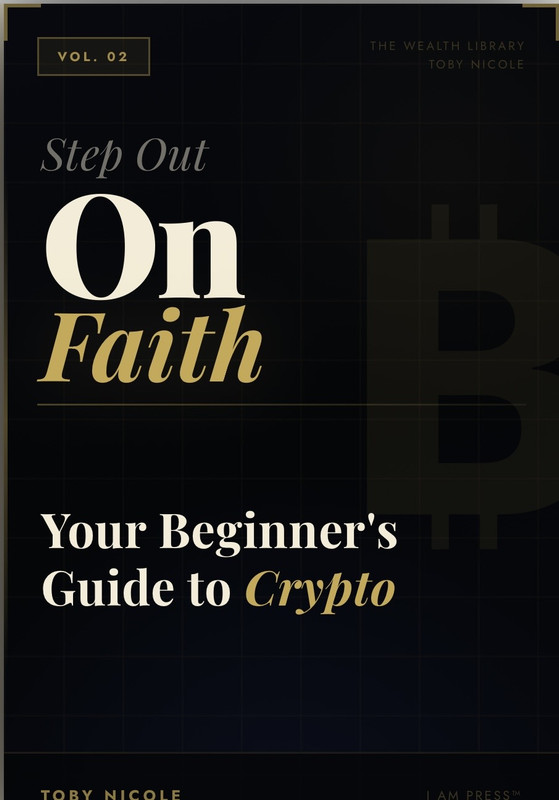
Step OutOn FaithVol. 02

Your Beginner's Guide to Crypto. Blockchain, digital assets, and how to start — without the hype, without the noise, and without risking what you can't afford to lose. 8 chapters. Plain English. Completely free.

Published by I Am Press™ · An Imprint of I Am My Own Asset® LLC
Step Out On Faith by Toby Nicole
New Release
Available NowVol. 02 — Free PDF
Published byI Am Press™
(function(){ var n=document.getElementById('tn-nav'); window.addEventListener('scroll',function(){n.classList.toggle('scrolled',window.scrollY>60);}); })();
Toby Nicole | Ticker
Toby Nicole
I Am My Own Asset®
Financial Freedom
Free Ebooks
XRP · XLM · XDC
Crypto Education
Retire Rich
Dollar Cost Average
Tokenized Finance
ISO 20022
Knowledge Is Power
Toby Nicole
I Am My Own Asset®
Financial Freedom
Free Ebooks
XRP · XLM · XDC
Crypto Education
Retire Rich
Dollar Cost Average
Tokenized Finance
ISO 20022
Knowledge Is Power
Toby Nicole | About

"The financial system was not built to teach you how it works. That's exactly why I will."

— Toby Nicole, I Am My Own Asset®
100%Always Free
0Barriers to Entry
More Ebooks Coming
1Mission: Your Growth
Who This Is For

For Anyone Who Wants to Learn But Doesn't Know Where to Start

Too many people are ready to take control of their financial future — but the information they need is buried, gatekept, or sold back to them at a price they can't afford yet.

I Am My Own Asset® was built on one belief: you are your greatest investment. Not a stock. Not a house. You. Your knowledge, your decisions, your financial future.

These ebooks are my way of handing you the map. Written in plain language, built on real strategies, and designed for the person who is done waiting and ready to start building — no matter where they're starting from.

Everything here is free. That's not a promotion. That's the point.

(function () { var els = document.querySelectorAll('.tn-reveal'); var obs = new IntersectionObserver(function (entries) { entries.forEach(function (e) { if (e.isIntersecting) e.target.classList.add('tn-visible'); }); }, { threshold: 0.08, rootMargin: '0px 0px -40px 0px' }); els.forEach(function (el) { obs.observe(el); }); })();
Toby Nicole | Ebooks
The Library

Free Ebooks by Toby Nicole

Download, read, share. Every book is completely free — always.

Published by I Am Press™  ·  An Imprint of I Am My Own Asset® LLC

More Knowledge Coming Soon
03
Finance · The Future

The Tokenization of Everything

The $16 trillion shift happening in global finance — and what it means for everyday people paying attention. Real assets. Digital rails. XDC Network. The future of money explained.

I Am Press™  ·  I Am My Own Asset® LLC
Coming Soon
(function () { var els = document.querySelectorAll('.tn-reveal'); var obs = new IntersectionObserver(function (entries) { entries.forEach(function (e) { if (e.isIntersecting) e.target.classList.add('tn-visible'); }); }, { threshold: 0.08, rootMargin: '0px 0px -40px 0px' }); els.forEach(function (el) { obs.observe(el); }); })();
Toby Nicole | Mission
The Belief

You don't need a finance degree.
You don't need a trust fund.
You don't need their permission.
You Need Information.

I started I Am My Own Asset® because I believe financial literacy is a right, not a privilege. The gap between those who build wealth and those who don't often comes down to one thing — access to the right information at the right time.

That's what this library is. Free. Forever. For you.

Start Reading Now
(function () { var els = document.querySelectorAll('.tn-reveal'); var obs = new IntersectionObserver(function (entries) { entries.forEach(function (e) { if (e.isIntersecting) e.target.classList.add('tn-visible'); }); }, { threshold: 0.08, rootMargin: '0px 0px -40px 0px' }); els.forEach(function (el) { obs.observe(el); }); })();
Toby Nicole | Connect
Stay in the Loop

Be First When a New Ebook Drops

No spam. No sales pitch. Just a heads-up when new free knowledge lands in the library. Unsubscribe anytime — no hard feelings.

Free. No commitment. I Am My Own Asset® LLC · Sheridan, Wyoming

(function () { var els = document.querySelectorAll('.tn-reveal'); var obs = new IntersectionObserver(function (entries) { entries.forEach(function (e) { if (e.isIntersecting) e.target.classList.add('tn-visible'); }); }, { threshold: 0.08, rootMargin: '0px 0px -40px 0px' }); els.forEach(function (el) { obs.observe(el); }); window.tnHandleForm = function (e) { e.preventDefault(); var btn = e.target.querySelector('.tn-email-btn'); var input = e.target.querySelector('.tn-email-input'); btn.textContent = '✓ You\'re on the list!'; btn.style.background = '#2D6A4F'; btn.style.color = '#fff'; input.value = ''; input.disabled = true; setTimeout(function () { btn.textContent = 'Notify Me'; btn.style.background = ''; btn.style.color = ''; input.disabled = false; }, 5000); }; })();
Toby Nicole | Footer
TMM | Sticky UI
I Am Press™The Million Dollar MistakeToby Nicole
⚠ Not financial advice  ·  For educational & entertainment purposes only  ·  Always consult a licensed financial professional
TMM | Cover
I Am Press™ · Free Financial Education

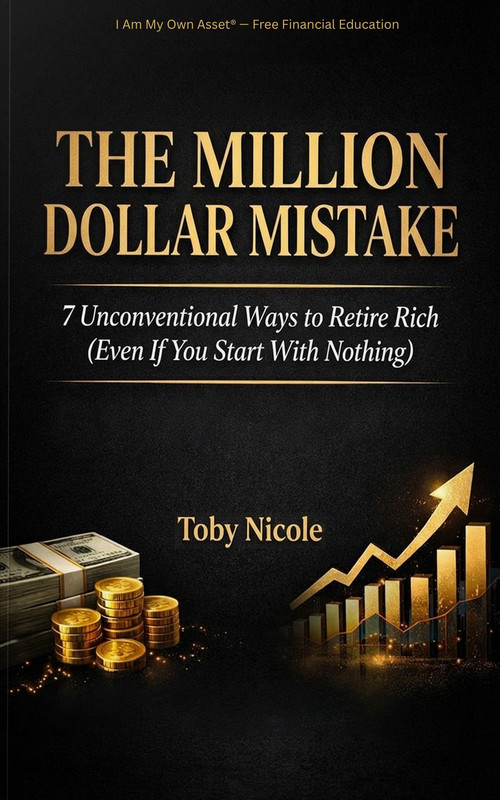
The Million
Dollar
Mistake

7 Unconventional Ways to Retire Rich

Toby Nicole

I Am My Own Asset® · I Am Press™

↓   Begin Reading

⚠ IMPORTANT DISCLAIMER — This book is for educational and entertainment purposes only. Nothing in this book constitutes financial, investment, legal, or tax advice. Toby Nicole is not a licensed financial advisor, investment advisor, or tax professional. All strategies discussed are based on personal research and experience. Past performance does not guarantee future results. Always consult with licensed professionals before making financial decisions. Investments carry risk, including the possible loss of principal.

TMM | Table of Contents
TMM | Author's Note
Author's Note

Why I Wrote This Book

The question that changed everything

For most of my life, I made the same mistake millions of Americans make every single day — I let money work against me instead of for me. Then COVID happened. The world stopped, and for the first time I had the space to sit still and actually ask why. Why was I working this hard and still not building real wealth? That question sent me down a rabbit hole I never came back from. I started researching financial systems, monetary policy, digital assets, and the infrastructure being quietly built underneath the global economy. What I found changed everything.

I spent 15 years in the transportation industry. I watched carriers wait 60, 90 days to get paid. I saw how money moves — or doesn't move — inside systems that were never designed to benefit ordinary working people. When I became an independent insurance adjuster, I saw it from another angle. I watched people lose everything because they never had the right information at the right time.

This book is what I wish someone had handed me twenty years ago. It's not a get-rich-quick scheme. There's no magic number and no secret formula. What's here are seven unconventional strategies that most financial media ignores, written from the perspective of someone who figured them out the hard way — through research, through loss, and through the kind of clarity that only comes when you finally stop running and start thinking.

"The million-dollar mistake isn't any one bad decision. It's the lifetime of smaller ones made without the full picture."

I'm not a licensed financial advisor. This is not financial advice. What it is — is financial education. The kind they never taught in school. The kind that, once you see it, you can't unsee.

⚠ Not financial advice · Educational purposes only · Consult a licensed professional
TMM | Ch.1 Geographical Arbitrage
Chapter 01

Geographical Arbitrage

Your zip code is costing you a fortune

Here's a concept most financial planners won't mention in their first three meetings with you: your retirement might be affordable — just not where you currently live. Geographical arbitrage is the strategy of moving to a lower-cost location to dramatically extend how far your savings reach. It sounds simple because it is. The complexity is in your willingness to consider it.

A retiree living on $3,500 a month in San Francisco or New York might be scraping by. That same $3,500 in Medellín, Colombia, Chiang Mai, Thailand, or Algarve, Portugal buys a genuinely comfortable life — sometimes with money left over. Countries in Latin America, Southeast Asia, and parts of Europe have built entire retirement visa ecosystems around attracting Americans and Europeans who bring their dollars, euros, and pensions with them.

The Numbers Don't Lie

According to various cost-of-living indexes, countries like Portugal, Mexico, and Panama consistently rank among the most popular retirement destinations for Americans — not just for culture or climate, but for pure economic value. Healthcare that costs $800 a month in the U.S. can run $100–$200 in many of these countries, with comparable or in some cases better quality of care for expats in private facilities.

LocationEst. Monthly Budgetvs. U.S. Average
San Francisco, CA$5,500–$7,000+Baseline
Austin, TX$3,500–$4,500~30% less
Medellín, Colombia$1,500–$2,500~60% less
Chiang Mai, Thailand$1,200–$2,000~70% less
Algarve, Portugal$2,000–$3,000~50% less
Playa del Carmen, Mexico$1,800–$2,800~55% less

This isn't about living cheap. This is about living well on less — freeing capital to compound instead of disappear into rent, property taxes, and the general cost of American consumer life.

What to Research First

Tax treaties between the U.S. and the destination country matter enormously. Some countries tax foreign income, some don't. The Foreign Earned Income Exclusion (FEIE) and Foreign Tax Credit are tools worth understanding before you pack a single box. American citizens living abroad still file U.S. taxes — that's not optional — but the impact can be significantly reduced with the right structure.

Healthcare access, visa requirements, banking access, and proximity to family are the four factors most retirees say they underestimated before moving. Research all four thoroughly. Build relationships in expat communities online before you commit to anything permanent.

"You worked for decades to build wealth. Why spend it all keeping up with a zip code that was never designed to make you rich?"

The cost estimates in this chapter are for general educational illustration only. Costs vary widely and change frequently. This is not a recommendation to move abroad or make any financial decision. Consult financial, legal, and tax professionals before making any relocation decisions.

⚠ Not financial advice · Educational purposes only
TMM | Ch.2 Bond Ladders
Chapter 02

Bond Ladders

Building predictable income in an unpredictable market

Most people think bonds are boring. They're not wrong — but boring, in retirement income planning, is often exactly what you want. A bond ladder is a strategy where you purchase bonds with staggered maturity dates, creating a predictable stream of income that hits at regular intervals over time. It's the financial equivalent of planting crops that harvest at different seasons so you always have something coming in.

The core idea: instead of putting $100,000 into one bond with a 10-year term, you split it across five bonds maturing at years 1, 2, 3, 4, and 5. Each year, a bond matures, returns your principal, and you reinvest it in a new 5-year bond — or use the cash if you need it. The ladder extends itself indefinitely as long as you keep rolling the proceeds forward.

Why It Works for Retirement

The primary risk in retirement is outliving your money. The secondary risk — one that gets far less attention — is being forced to sell assets at the wrong time because you need cash. A bond ladder addresses both. It gives you known cash flows at predictable intervals, which means you're never in a position where a market crash forces you to liquidate equities to pay your electric bill.

BondAmountMaturityEst. Annual Income*
Bond 1$20,000Year 1~$900–$1,100
Bond 2$20,000Year 2~$900–$1,100
Bond 3$20,000Year 3~$1,000–$1,200
Bond 4$20,000Year 4~$1,000–$1,200
Bond 5$20,000Year 5~$1,100–$1,300

*Estimates for illustration only. Actual yields vary with market conditions. Not a guarantee of return.

Types of Bonds to Understand

U.S. Treasury bonds are backed by the federal government and are considered among the lowest-risk fixed-income instruments available. Corporate bonds carry higher yields but also higher credit risk. Municipal bonds offer potential tax advantages for certain investors depending on their tax bracket and state. I-Bonds, issued by the U.S. Treasury, adjust for inflation and have attracted significant attention in high-inflation environments.

Understanding the difference between yield, coupon rate, and total return is essential before building any bond strategy. These are concepts worth researching deeply or discussing with a licensed financial advisor who specializes in fixed income.

"In retirement, predictability isn't boring. Predictability is freedom."

A Note on the Current Environment

No strategy exists in a vacuum — and bond investing is directly affected by the broader economic and political climate. As of this writing, there is significant uncertainty in the U.S. bond market driven by tariff policy, rising government debt, and questions about long-term fiscal direction. Tariff volatility has triggered sell-offs in long-term Treasuries, pushing yields up and bond prices down. The traditional relationship where bonds rise when stocks fall — the classic hedge — has also weakened in recent years.

This doesn't make bond ladders obsolete. It makes the type of bond you choose and the duration of your ladder more important than ever. Shorter-duration bonds carry less interest rate risk. Treasury Inflation-Protected Securities (TIPS) are designed specifically to maintain value against inflation. Municipal bonds may offer tax advantages worth exploring depending on your situation.

The core principle of the bond ladder — predictable income at staggered intervals — remains sound. What requires more attention right now is the quality of the bonds inside that ladder and how sensitive they are to a volatile rate environment. This is precisely why working with a licensed fixed-income specialist matters more today than it did a decade ago.

Bond investing involves risk including interest rate risk, credit risk, inflation risk, and political/fiscal risk. The current economic environment adds additional uncertainty to long-term fixed income strategies. The examples in this chapter are for educational illustration only and do not represent actual investment products or guaranteed returns. Always work with a licensed financial advisor who specializes in fixed income before making any bond investment decisions.

⚠ Not financial advice · Educational purposes only
TMM | Ch.3 + Ch.4
Chapter 03

The Passion Economy

What you know has value someone will pay for

There's a question I want you to sit with: What have you spent the last 20 or 30 years getting good at? Not your job title. Not your industry. What do you actually know that most people don't? Because in the modern economy, that knowledge is a potential income stream — and it doesn't require a storefront, a startup, or a business loan.

The passion economy is built on the idea that individuals can monetize expertise, skills, and interests directly — without gatekeepers. A retired nurse who understands medication interactions can build an audience of caregivers hungry for plain-language guidance. A former mechanic can create video tutorials. A 30-year teacher can build a tutoring business. An insurance adjuster who spent years watching claims get mishandled can help policyholders understand their rights. The internet removed the middleman between what you know and the people who need to know it.

Platforms to Explore

Substack, Patreon, YouTube, Teachable, Gumroad, and Etsy are among the platforms that allow individuals to generate income from knowledge and creativity. Each has a different model — subscriptions, courses, digital downloads, physical products — and different levels of technical complexity to get started.

The critical point for retirement planning is not that you should build a massive business. The goal might simply be generating $500–$2,000 per month in supplemental income that reduces how much you need to withdraw from retirement accounts. That compression effect — drawing less from savings — can meaningfully extend the life of a portfolio over 20–30 years.

What to Watch Out For

Platform risk is real. Any income stream that depends entirely on one platform is vulnerable. Diversification across platforms, combined with building an owned email list, reduces this risk. Tax treatment of self-employment income, including quarterly estimated taxes and self-employment tax, is something to understand before the income starts flowing. A CPA familiar with self-employment is worth consulting early.

"Retirement doesn't mean your knowledge expires. It might be the first time in your life you get to decide who it serves."

⚠ Not financial advice · Educational purposes only
TMM | Ch.3 + Ch.4
Chapter 04

HECM Reverse Mortgage

The misunderstood tool hiding in your home equity

Few financial products carry more stigma than the reverse mortgage — and few are more misunderstood. The fear usually goes like this: you take out a reverse mortgage, and then the bank takes your house. That's not how a properly structured Home Equity Conversion Mortgage (HECM) works. But the misunderstanding has kept a genuinely useful retirement tool out of reach for millions of homeowners who could benefit from it.

A HECM is a federally insured reverse mortgage available to homeowners 62 and older. Instead of making payments to a lender, you receive payments — or a line of credit — based on the equity you've built in your home. You remain on the title. You remain in the home as long as it's your primary residence. The loan doesn't come due until you sell, move out permanently, or pass away.

The Line of Credit Strategy

One of the least-discussed features of the HECM is the line of credit option — and it has a characteristic that surprises most people who learn about it. The unused portion of a HECM line of credit grows over time at a rate tied to the loan's interest rate. This means the longer you leave it untouched, the more borrowing capacity you accumulate. Some researchers in retirement planning literature have described this as one of the more powerful — and most underutilized — features in the retirement toolkit.

The strategic use case: establish the line of credit early in retirement. Leave it untouched during good market years. In a down market — when liquidating investments would lock in losses — draw from the HECM line of credit instead. This sequence-of-returns protection can significantly extend portfolio longevity.

What You Must Understand First

HECM loans are federally insured and regulated. Mandatory HUD-approved counseling is required before any application — that's a feature, not a bug. The counseling exists to ensure borrowers understand the full picture: costs, obligations, how heirs are affected, and alternatives. Property taxes, homeowner's insurance, and maintenance remain your responsibility. Failure to maintain them can trigger the loan.

"For the right person at the right time, a HECM isn't a last resort. It's a financial tool that most advisors never learned how to use."

Reverse mortgage products are complex and carry significant financial implications. Nothing in this chapter constitutes a recommendation to pursue a HECM or any reverse mortgage product. Eligibility requirements, terms, and regulations change. Always consult with a HUD-approved housing counselor and a licensed financial advisor before making any decisions.

⚠ Not financial advice · Educational purposes only
TMM | Ch.5 + Ch.6
Chapter 05

Late-Career Entrepreneurship

The startup advantage no one talks about

The cultural narrative says entrepreneurship is for the young. Move fast. Take risks. Sleep under your desk. But the data tells a different story. Research from MIT and the National Bureau of Economic Research has found that the average age of founders of successful startups is closer to 45 than 25 — and that founders in their 50s outperform those in their 20s by several meaningful measures. Experience, networks, and pattern recognition are not liabilities. They're advantages.

Late-career entrepreneurship as a retirement strategy isn't about building the next unicorn. It's about converting accumulated professional expertise into an income-generating asset that can supplement or replace traditional retirement income — ideally one with lower overhead, flexible hours, and genuine personal meaning.

Models That Work for Later-Stage Founders

Consulting and fractional executive work are among the most efficient late-career entrepreneurship models. If you spent 25 years in supply chain management, operations, healthcare administration, or finance, companies — particularly smaller ones — will pay meaningful rates for that expertise on a project or part-time basis. You're not taking someone's full-time job. You're solving problems they can't solve internally.

Licensing intellectual property — processes, systems, methodologies you developed over a career — is another avenue that generates passive or semi-passive income without requiring daily operations. A franchise model, micro-franchise, or buying an existing small business with proven cash flows are paths that experienced operators often navigate more successfully than first-time entrepreneurs.

The Retirement Account Angle

A legitimate business creates an opportunity to contribute to a Solo 401(k) or SEP-IRA — potentially allowing contributions that exceed standard IRA limits. For someone who got a late start on retirement savings, this is one of the most powerful catch-up mechanisms available. A tax professional who works with self-employed individuals can model the specific impact for your situation.

"Nobody told us that 55 might be the best possible time to start — because by then, you've already made most of the expensive mistakes."

⚠ Not financial advice · Educational purposes only
TMM | Ch.5 + Ch.6
Chapter 06

Delayed Social Security

The 8% guaranteed return hiding in plain sight

Most Americans claim Social Security as soon as they can — at 62. The logic feels sound: take the money now, get more years of payments. But the math often works out differently. For every year you delay claiming Social Security past your full retirement age (currently 66–67 for most people), your benefit increases by approximately 8% per year — up to age 70. That's a guaranteed, inflation-adjusted return that no stock, bond, or savings account can match without taking on market risk.

The difference between claiming at 62 versus 70 can exceed $1,000 per month in higher monthly income — for the rest of your life. For someone who lives into their 80s or 90s, the total lifetime benefit of delaying can exceed $100,000–$200,000 in additional income compared to early claiming.

The Break-Even Calculation

The math depends on your break-even age — the point at which the cumulative higher payments from delaying surpass the cumulative payments you would have received by claiming early. For most people, that break-even falls somewhere in the mid-to-late 70s. If you expect to live past that age, delayed claiming typically wins on pure math.

Claiming AgeEst. Monthly Benefit*Annual Benefit*
62 (Early)~$1,400~$16,800
67 (Full Retirement Age)~$2,000~$24,000
70 (Maximum Delay)~$2,480~$29,760

*Illustrative estimates only. Actual benefits depend on your individual earnings history. Visit ssa.gov for your personal estimate.

The Bridge Strategy

The challenge with delaying is that you need income in the years before you claim. The bridge strategy involves drawing down other assets — IRA, 401(k), investments, or part-time income — during the delay period, treating it as a temporary drawdown in exchange for a permanently higher lifetime income stream. Whether this makes sense depends heavily on your individual health history, other income sources, tax situation, and retirement timeline. This is a strategy worth modeling carefully with a financial planner.

"The most reliable 8% return in the history of retirement planning isn't in the stock market. It's in a decision most people make wrong."

Social Security rules, benefit calculations, and claiming strategies are complex and depend on individual circumstances. This is for educational purposes only. Visit ssa.gov for personalized benefit estimates and consult a licensed financial advisor for claiming strategy advice.

⚠ Not financial advice · Educational purposes only
TMM | Ch.7 Dynamic Withdrawal Rules
Chapter 07

Dynamic Withdrawal Rules

Why the 4% rule is a starting point, not a finish line

The 4% rule is the most widely cited guideline in retirement income planning. The idea: if you withdraw 4% of your portfolio in year one of retirement and adjust for inflation each subsequent year, your portfolio has historically had a high probability of lasting 30 years. It came from a 1994 study by financial planner William Bengen and was a landmark piece of research. It's also a blunt instrument.

The rule assumes a fixed annual withdrawal regardless of what markets are doing. In a year when your portfolio drops 30%, a rigid 4% rule still takes the same inflation-adjusted withdrawal — locking in real losses and potentially setting you on a path toward portfolio depletion. Dynamic withdrawal strategies adjust the amount you take based on actual portfolio performance, reducing withdrawals in down years and allowing more in up years.

Guardrail Strategies

One well-researched approach sets upper and lower "guardrails" around a target withdrawal rate. If strong market performance pushes your portfolio significantly above projections, you may allow a modest spending increase. If a downturn pushes the portfolio below a threshold, spending gets trimmed — by a predetermined amount, not a panic-driven slash. This systematic flexibility has been shown in various research to significantly outperform rigid fixed-rate approaches over long retirement horizons.

The Floor and Upside Model

Another framework distinguishes between essential and discretionary spending. Essential spending — housing, healthcare, food, utilities — gets covered by guaranteed income sources: Social Security, pension, annuity, or bond ladder. Discretionary spending — travel, gifts, dining — gets funded from investment portfolios. In bad market years, discretionary spending contracts naturally. Essential spending never depends on a portfolio that might be down.

StrategyHow It WorksKey Benefit
Fixed 4% RuleSame withdrawal each year, inflation adjustedSimplicity
GuardrailsAdjust based on portfolio performance bandsMarket-responsive
Floor & UpsideGuaranteed income for essentials, portfolio for discretionarySecurity + flexibility
Dynamic %Recalculate % annually based on current balanceNever depletes

"A rule built in 1994 for a 30-year retirement wasn't designed for someone who might live to 95. Dynamic beats rigid every time."

Withdrawal strategies involve complex interactions between market performance, tax rules, healthcare costs, and longevity. Historical performance does not guarantee future results. This is educational content only. Work with a licensed financial planner to model withdrawal strategies specific to your situation.

⚠ Not financial advice · Educational purposes only
TMM | Bonus — XRP, XLM & XDC
Bonus Chapter

XRP, XLM & XDC

What I found at the bottom of the rabbit hole

⚠ CRYPTO DISCLAIMER — Digital assets are highly speculative, volatile, and unregulated in many jurisdictions. This chapter documents personal research and experience only. It is not a recommendation to buy, sell, or hold any digital asset. Cryptocurrency investments carry the risk of total loss. Always conduct your own research and consult a licensed financial professional before considering any digital asset investment.

When I went down the research rabbit hole during COVID, I wasn't looking for cryptocurrency. I was looking to understand why the financial system works the way it does — why money moves slowly, why payments get stuck, why a trucking company can haul a load across the country and wait 90 days to get paid. What I found, when I followed those questions far enough, was a category of digital assets being built specifically to solve problems in the global payment and settlement infrastructure.

Three assets kept surfacing in my research: XRP, XLM, and XDC. Not because of price speculation or get-rich-quick narratives. Because of what they're designed to do at an infrastructure level — and who is building around them.

XRP & Ripple

XRP is the native digital asset of the XRP Ledger, a blockchain developed by Ripple. Ripple's stated mission is to enable real-time, low-cost international payments and settlement. The traditional correspondent banking system for international wire transfers can take 2–5 days and cost significant fees. RippleNet is a payment network used by financial institutions in multiple countries that aims to compress that timeline dramatically.

XRP's ISO 20022 compliance is a key data point in my research. ISO 20022 is an international standard for financial messaging — essentially a common language for how banks and payment systems communicate. The Society for Worldwide Interbank Financial Telecommunication (SWIFT) has been migrating its global network to ISO 20022 standards. Ripple was admitted to the ISO 20022 Standards Body. The significance of that, in terms of long-term infrastructure positioning, is something I've spent considerable time thinking about.

XLM & Stellar

XLM is the native asset of the Stellar network. Where Ripple has focused primarily on institutional payment corridors, Stellar has oriented around financial inclusion — enabling low-cost cross-border payments for individuals in underserved markets. The Stellar Development Foundation has partnered with organizations working in remittance corridors in Africa, Latin America, and Southeast Asia. XLM is also ISO 20022 compliant.

XDC & XinFin

XDC is the native asset of the XDC Network, built by XinFin. The XDC Network has positioned itself specifically around trade finance — the financing of international trade transactions. Trade finance is a multi-trillion dollar market that still runs largely on paper-based processes and slow settlement cycles. XDC's architecture is designed for tokenizing real-world assets (RWA) and enabling faster, more transparent settlement of trade finance instruments. It has also achieved ISO 20022 compatibility.

"I'm not in crypto because of price charts. I'm in it because of where the infrastructure is going — and who's building it."

I hold XRP, XLM, and XDC as part of my personal portfolio. I am documenting my research, not recommending my choices. The digital asset space is volatile, evolving, and carries real risk of loss. None of this is financial advice.

⚠ Not financial advice · Crypto is high-risk · Educational purposes only
TMM | Ch.9 + Ch.10
Chapter 09

Choosing a Crypto Exchange

Not all platforms are built the same

If you've decided — after your own research — that you want to explore digital assets, the first practical question is where to buy them. A cryptocurrency exchange is a platform that allows you to purchase, sell, and hold digital assets. The differences between platforms matter significantly and affect your security, costs, access to assets, and legal protections.

Key Factors to Evaluate

Regulatory compliance is the starting point. In the U.S., exchanges that are registered with FinCEN and operate under appropriate state money transmission licenses provide a baseline level of accountability. Some exchanges have faced regulatory action — that history is public record and worth researching before depositing funds.

Custodial vs. non-custodial is a fundamental distinction. On a custodial exchange, the platform holds your assets on your behalf. If the platform fails, is hacked, or freezes withdrawals — as has happened with multiple exchanges in recent years — your access to your assets may be impaired. Non-custodial options give you direct control over your private keys.

FactorWhat to Look For
RegulationFinCEN registered, state licensed, transparent legal history
Security2FA required, cold storage for customer assets, insurance
FeesTrading fees, withdrawal fees, spread on purchases
Asset SelectionDoes it support XRP, XLM, XDC, and other assets you research?
Withdrawal AccessCan you send assets to your own wallet?
Customer SupportResponsive, documented, accessible

The phrase "not your keys, not your coins" became a hard lesson for many investors during the FTX collapse in 2022. Understanding the difference between holding assets on an exchange and holding them in a self-custody wallet is essential education before you move any significant amount of capital into the space.

⚠ Not financial advice · Educational purposes only
TMM | Ch.9 + Ch.10
Chapter 10

Hardware Wallet Security

If it's not in your wallet, it's not yours

A hardware wallet — sometimes called a cold wallet — is a physical device that stores the private keys to your cryptocurrency offline, disconnected from the internet. It's the digital equivalent of a safe deposit box, except you hold the only key. When you store crypto on an exchange, the exchange holds the keys on your behalf. When you move it to a hardware wallet, you hold the keys yourself — and no exchange failure, hack, or regulatory action can freeze your access.

How It Works

When you set up a hardware wallet, you're given a seed phrase — typically 12 or 24 words in a specific sequence. This seed phrase is the master key to all assets stored in that wallet. If the device is lost, stolen, or damaged, the seed phrase allows complete recovery on a new device. The seed phrase is not a password to remember — it's a physical document to store securely, offline, in multiple protected locations. It should never be photographed, typed into any online platform, or shared with anyone.

Best Practices

Store seed phrase copies in two or more physically separate secure locations. A fireproof safe at home and a safety deposit box at a bank are common approaches. Metal seed phrase storage plates (designed to survive fire and water) are available from multiple vendors and are worth considering for significant holdings. Never store the seed phrase digitally — not in a note app, email draft, cloud document, or photograph.

Verify the address displayed on the hardware wallet's screen before confirming any transaction. Malware on a connected computer can substitute a different receiving address without your knowledge — hardware wallets protect against this by requiring physical button confirmation on the device itself.

Security PracticeWhy It Matters
Seed phrase offline onlyDigital copies are hackable
Multiple physical copiesProtects against single point of loss
Verify on-device addressPrevents address substitution malware
Buy direct from manufacturerPrevents tampered pre-loaded devices
Test recovery before fundingConfirms seed phrase works before large deposits

"Your seed phrase is not a password. It is your wealth. Treat it accordingly."

⚠ Not financial advice · Educational purposes only
TMM | Closing + About + Footer
Closing

You Are the Asset

The only investment that can never be taken from you

Every strategy in this book — geographical arbitrage, bond ladders, the passion economy, HECM credit lines, late-career entrepreneurship, delayed Social Security, dynamic withdrawals, digital assets — is just a tool. Tools matter. But the person who picks up the tool and actually uses it matters more.

The million-dollar mistake isn't any single financial error. It's the lifetime of decisions made without the full picture. It's the assumption that someone else is handling it. It's the belief that financial education is for other people — people with more time, more money, more background. None of that is true.

You are the most valuable asset in your financial life. Not your portfolio. Not your real estate. Not your savings account. You — your decision-making, your willingness to learn, your consistency over time. Everything else is downstream of that.

"You are your own most valuable asset. Everything else is just a tool."

Please work with licensed professionals. Please do your own research. Please don't let this book — or any book — be the last word on your financial decisions. Use it as a starting point, not a finish line.

I Am My Own Asset®. I Am The Asset™.

— Toby Nicole · I Am Press™ · Not Financial Advice

⚠ Not financial advice · For educational & entertainment purposes only
About the Author

Toby Nicole

Toby Nicole is the founder of I Am My Own Asset® LLC. With 15 years in the transportation industry and an active career as an independent insurance adjuster, she has spent years watching how money moves — and how often it doesn't — inside systems that were never designed to benefit ordinary working people.

During COVID, Toby went deep researching financial systems, monetary policy, digital assets, and global payment infrastructure. That research became the foundation of I Am My Own Asset® — a financial education brand built on the belief that information is the most powerful asset anyone can own.

She is the founder of I Am Press™, Bullish On Me™, and is building IAMOA Brokerage. She creates financial education content at @iammyownasset covering ISO 20022, tokenization, XRP, XLM, and XDC. I Am My Own Asset® is federally registered. Toby Nicole is not a licensed financial advisor — everything shared is from personal journey and research.

SOOF | Sticky UI
I Am Press™Step Out On FaithToby Nicole
⚠ Not financial advice  ·  For educational & entertainment purposes only  ·  Always consult a licensed financial professional
SOOF | Cover
I Am Press™ · Free Financial Education

Step Out
On Faith

Your Beginner's Guide to Crypto

Toby Nicole

I Am My Own Asset® · I Am Press™

↓   Begin Reading

⚠ IMPORTANT DISCLAIMER — This book is for educational and entertainment purposes only. Nothing in this book constitutes financial, investment, legal, or tax advice. Toby Nicole is not a licensed financial advisor. Digital assets are highly speculative and volatile. Cryptocurrency investments carry the risk of total loss. Always conduct your own research and consult a licensed financial professional before making any investment decisions.

SOOF | Table of Contents
SOOF | Ch.1 + Ch.2
Chapter 01

What Is Crypto

The early internet moment most people are sleeping on

The first Bitcoin conference was held in August 2011. Fewer than 100 people showed up. Bitcoin was trading between $8 and $11. The people in that room weren't wealthy speculators — they were early believers in an idea that most of the world hadn't even heard of yet. By 2025, Bitcoin reached $126,198. The people who showed up in 2011 didn't know the price would do that. What they understood was the technology.

Cryptocurrency is digital money — but that definition undersells what it actually is. It's a new kind of financial infrastructure. It's a way to move value across the internet the same way we move information — instantly, without asking permission from a bank, a government, or a payment processor.

We are at an early internet moment right now. Not with social media or streaming — with money itself. The global financial system is being rebuilt from the ground up, and most people won't realize it happened until it already has.

"I'm not asking you to believe the price will go up. I'm asking you to understand what's being built — and why it matters."

That's what this book is about. Not price predictions. Not get-rich-quick. The infrastructure. The technology. The reason why institutions, central banks, and governments are paying attention — even when they're publicly skeptical.

⚠ Not financial advice · Educational purposes only
SOOF | Ch.1 + Ch.2
Chapter 02

What Is Blockchain

The ledger that nobody owns and everybody can see

Before you can understand crypto, you have to understand blockchain — because blockchain is the technology that makes crypto possible. And once you understand blockchain, you'll start seeing why this technology goes far beyond just digital money.

A blockchain is a ledger. A record of transactions. But instead of being stored in one place — like a bank's database — it's copied across thousands of computers around the world simultaneously. Every transaction is recorded in a block. That block gets added to a chain of previous blocks. Hence: blockchain.

The critical feature is that no single person, company, or government controls it. There's no central point of failure. No one can go in and quietly change the records. Once a transaction is confirmed on a blockchain, it's permanent and visible to anyone who wants to verify it.

Why That Matters

Think about how much of our financial system runs on trust in intermediaries. We trust banks to hold our money accurately. We trust wire transfer systems to route payments correctly. We trust that the records won't be altered. Blockchain makes trust a technical guarantee instead of a social one. The math enforces it — not a person, not an institution.

"Blockchain doesn't ask you to trust the bank. It asks you to trust the math."

⚠ Not financial advice · Educational purposes only
SOOF | Ch.3 + Ch.4
Chapter 03

The Money Problem

Why the system was never built for people like us

I spent 15 years in the transportation industry. I watched carriers haul freight across the country — sometimes across multiple states, sometimes across borders — and then wait 60, 90, even 120 days to get paid. Not because the money didn't exist. Because of the system. Because of the way payments move through correspondent banks, through clearinghouses, through layers of intermediaries that each take time and often take fees.

I became an independent insurance adjuster and saw it from another angle. I watched policyholders wait weeks for settlements that should have taken days. I watched small business owners unable to make payroll because a payment was "in processing." The money existed. The system just wasn't built to move it efficiently — especially not for ordinary people without the leverage to demand better.

The Global Picture

Globally, the traditional international wire transfer system — built on correspondent banking relationships and the SWIFT messaging network — can take 2 to 5 business days. It charges significant fees. It operates on banking hours. It was built in the 1970s and largely still runs on 1970s logic.

There are 1.4 billion unbanked adults in the world. People without access to basic financial services — not because they're too poor to participate in the economy, but because the infrastructure was never built to reach them. The money problem isn't just about slow wires. It's about who the system was designed to serve.

"When I tell you the financial system is broken, I'm not reading that off a website. I lived it. That's why when I talk about what's being built to replace it — I'm connecting dots most people don't even know exist."

⚠ Not financial advice · Educational purposes only
SOOF | Ch.3 + Ch.4
Chapter 04

XRP & Ripple

The bridge currency being built into the financial system

⚠ Crypto Disclaimer — XRP is a digital asset. This chapter documents personal research only. It is not a recommendation to buy, sell, or hold XRP or any digital asset. Digital assets are highly speculative and carry the risk of total loss. Always do your own research.

XRP is the native digital asset of the XRP Ledger — a blockchain developed with speed and payment efficiency as its core design goals. Where Bitcoin was built as a store of value and Ethereum as a programmable platform, the XRP Ledger was built specifically to move money — fast, cheap, and at scale.

Ripple is the company that develops solutions on the XRP Ledger. Its flagship product, RippleNet, is a payment network used by financial institutions across multiple countries. The stated goal is to replace the correspondent banking model for international payments — compressing settlement from days to seconds, and fees from dollars to fractions of a cent.

The ISO 20022 Connection

ISO 20022 is an international standard for financial messaging — essentially a common language for how banks, payment systems, and financial infrastructure communicate with each other. SWIFT, the global network that connects over 11,000 financial institutions in more than 200 countries, completed its migration to ISO 20022 standards with a mandate effective November 22, 2025.

Ripple was admitted to the ISO 20022 Standards Body — the governing organization that sets these global financial messaging standards. That admission places Ripple in the same room as central banks, major financial institutions, and global payment infrastructure providers. The significance of that positioning is something I've spent considerable time researching and thinking about.

"XRP wasn't built for retail speculation. It was built for the infrastructure layer of global finance."

I hold XRP as part of my personal portfolio. I am documenting my research — not recommending my choices. This is not financial advice.

⚠ Not financial advice · Crypto is high risk · Educational purposes only
SOOF | Ch.5 + Ch.6
Chapter 05

XLM & Stellar

Financial inclusion built into the protocol

⚠ Crypto Disclaimer — XLM is a digital asset. This chapter documents personal research only. Not a recommendation to buy, sell, or hold any digital asset. Always do your own research.

XLM is the native asset of the Stellar network. Where Ripple has oriented primarily around institutional payment corridors — bank to bank, institution to institution — Stellar has built its mission around financial inclusion. The Stellar Development Foundation (SDF) focuses on enabling low-cost, fast cross-border payments for individuals in underserved and unbanked communities globally.

Stellar's architecture is designed for interoperability — the ability to move value across different currencies, assets, and financial networks without friction. A person in the Philippines can receive a payment from a family member in the United States in seconds, converted automatically through XLM as a bridge asset, at a fraction of the cost of a traditional remittance service.

ISO 20022 & Real World Use

XLM is ISO 20022 compatible — meaning it speaks the same financial messaging language now required by SWIFT and the global banking system. The Stellar Development Foundation has established partnerships with organizations working in remittance corridors across Africa, Latin America, and Southeast Asia. These aren't speculative future use cases — they are active deployments moving real value for real people right now.

"Stellar was built for the people the old system forgot. That's not marketing language — it's in the protocol design."

I hold XLM as part of my personal portfolio. This is documented research, not financial advice.

⚠ Not financial advice · Educational purposes only
SOOF | Ch.5 + Ch.6
Chapter 06

XDC & XinFin

Trade finance meets blockchain

⚠ Crypto Disclaimer — XDC is a digital asset. This chapter documents personal research only. Not a recommendation to buy, sell, or hold any digital asset. Always do your own research.

XDC is the native asset of the XDC Network, built by XinFin. While XRP and XLM focus primarily on payment settlement, XDC has positioned itself specifically around trade finance — the financing of international trade transactions. This is a multi-trillion dollar market that still operates largely on paper-based processes, slow settlement cycles, and layers of manual verification.

Trade finance involves letters of credit, bills of lading, invoices, and financial instruments that move between importers, exporters, banks, and logistics companies across multiple countries. The process can take weeks. Errors are common. Fraud is a known problem. The XDC Network's architecture is designed to tokenize these real-world trade finance instruments — putting them on blockchain so they settle faster, more transparently, and with less friction.

Real World Assets

The tokenization of real-world assets (RWA) is one of the most discussed trends in institutional blockchain adoption. XDC has positioned itself at the center of this conversation — specifically for trade finance tokenization. It has achieved ISO 20022 compatibility, placing it in alignment with the global financial messaging standard now required across the banking system.

"XDC is doing for trade finance what XRP is doing for payments. Most people haven't connected those dots yet."

I hold XDC as part of my personal portfolio. This is documented research, not financial advice.

⚠ Not financial advice · Educational purposes only
SOOF | Ch.7 + Ch.8
Chapter 07

ISO 20022

The global financial language most people have never heard of

ISO 20022 is an international standard for financial messaging. Think of it as a universal language that banks, payment systems, and financial infrastructure use to communicate with each other. Before ISO 20022, different financial institutions used different messaging formats — which created friction, errors, and incompatibility every time money moved across systems or borders.

SWIFT — the Society for Worldwide Interbank Financial Telecommunication — connects over 11,000 financial institutions across more than 200 countries. Every major international wire transfer touches SWIFT. And SWIFT completed its migration to ISO 20022 with a mandate that became effective November 22, 2025. That's not a future event. It already happened.

Why This Matters for Crypto

ISO 20022 compliance is becoming a baseline requirement for any digital asset that wants to operate inside the regulated global financial system. Assets that speak this language can integrate with the infrastructure that already moves trillions of dollars every day. Assets that don't are building outside the system — which limits their institutional adoption potential significantly.

XRP, XLM, and XDC are all ISO 20022 compatible. That's not a coincidence — it's a design choice by their respective development teams to position these assets for institutional use. Ripple was admitted to the ISO 20022 Standards Body itself. That level of involvement in the standards-setting process is notable regardless of how you feel about the price of any particular asset.

"ISO 20022 is the financial system's new operating language. The assets that speak it fluently are already inside the room."

⚠ Not financial advice · Educational purposes only
SOOF | Ch.7 + Ch.8
Chapter 08

Wallets & Security

Not your keys, not your coins

Before you buy a single dollar of cryptocurrency, you need to understand wallets — because where you store your crypto determines whether you actually own it. This is not a minor technical detail. It is the most important security decision you will make in the entire crypto space.

There are two types of wallets: custodial and non-custodial. A custodial wallet is one where a third party — typically an exchange — holds the private keys to your assets on your behalf. A non-custodial wallet is one where you hold the keys yourself. The phrase in this space is: "not your keys, not your coins." The FTX collapse in 2022 made this lesson brutally clear for millions of people who thought their assets were safe on an exchange.

Hardware Wallets

A hardware wallet is a physical device that stores your private keys completely offline — disconnected from the internet. It is the highest level of security available to individual crypto holders. When you set up a hardware wallet you receive a seed phrase — typically 12 or 24 words. This seed phrase is the master key to everything stored in that wallet. Store it offline. Store it in multiple physically secure locations. Never photograph it. Never type it into any website or app. Never share it with anyone for any reason.

"Your seed phrase is not a password. It is your wealth. Treat it accordingly."

Security practices in the digital asset space are critical. Loss of a seed phrase means permanent loss of assets. No customer service can recover them. Hardware wallets should be purchased directly from manufacturers only. Always verify wallet addresses on the device screen before confirming transactions.

⚠ Not financial advice · Educational purposes only
SOOF | Ch.9 + Ch.10
Chapter 09

How to Start

With what you have, where you are, right now

The most common reason people don't start investing in anything — crypto included — is that they're waiting until they have more money. More knowledge. More certainty. More time. The research on this is consistent: waiting is usually more costly than starting imperfectly with a small amount.

Dollar-cost averaging (DCA) is the practice of investing a fixed amount at regular intervals regardless of price. Instead of trying to time the market — buying at the bottom, selling at the top, which almost nobody does successfully — you invest consistently over time. Some of your purchases will be at higher prices. Some will be at lower prices. Over time the average smooths out.

A Starting Framework

Start with an amount you can afford to lose entirely. That is not pessimism — that is how you should think about any speculative asset class. The crypto market is volatile. Assets can drop 50%, 70%, 80% from peak to trough. If you invest money you cannot afford to lose, those drops will force you into decisions driven by fear instead of strategy.

Choose a regulated, reputable exchange with strong security practices. Enable two-factor authentication immediately. Research the assets you're considering based on their technology, use case, and team — not based on social media hype or price charts alone. Consider a hardware wallet once your holdings reach a level worth protecting from exchange risk.

"You don't need to buy a whole Bitcoin. You don't need $10,000 to start. You need a decision and a system."

Starting to invest in cryptocurrency involves real financial risk including the possible loss of your entire investment. Nothing here is a recommendation of any specific exchange, asset, or strategy. Always conduct your own research and consult a licensed financial professional.

⚠ Not financial advice · Educational purposes only
SOOF | Ch.9 + Ch.10
Chapter 10

The Mindset

This is infrastructure investing, not gambling

The people who lose money in crypto are usually operating with a gambling mindset — chasing price, following hype, making decisions based on fear and greed. The people who build real wealth in any asset class — stocks, real estate, or digital assets — are operating with an infrastructure mindset. They're asking different questions.

Not "how high will the price go?" but "what problem does this solve, and how important is that problem to the global economy?" Not "when should I sell?" but "what is my thesis, and what would have to change for that thesis to be wrong?" Not "is everyone else buying this?" but "do I understand what I own?"

Patience Is the Strategy

Infrastructure takes time to build. The internet was invented in the late 1960s. Email became mainstream in the 1990s. Smartphones changed everything in the 2000s. Each wave looked obvious in hindsight and uncertain in real time. The people who built wealth in each wave were not the ones who timed it perfectly — they were the ones who understood what was being built and had the patience to hold through the uncertainty.

I am not telling you that XRP, XLM, or XDC will make you wealthy. I am telling you what I researched, what I believe about the infrastructure being built, and what my personal strategy looks like. Your research, your risk tolerance, and your timeline are different from mine. This is your journey. Step out on faith — with your eyes wide open.

"I Am My Own Asset. And so are you."

I Am My Own Asset®. I Am The Asset™.

— Toby Nicole · I Am Press™ · Not Financial Advice

⚠ Not financial advice · For educational & entertainment purposes only
SOOF | About + Footer
About the Author

Toby Nicole

Toby Nicole is the founder of I Am My Own Asset® LLC. With 15 years in the transportation industry and an active career as an independent insurance adjuster, she has spent years watching how money moves — and how often it doesn't — inside systems that were never designed to benefit ordinary working people.

During COVID, Toby went deep researching financial systems, monetary policy, digital assets, and global payment infrastructure. That research became the foundation of I Am My Own Asset® — a financial education brand built on the belief that information is the most powerful asset anyone can own.

She is the founder of I Am Press™, Bullish On Me™, and is building IAMOA Brokerage. She creates financial education content at @iammyownasset covering ISO 20022, tokenization, XRP, XLM, and XDC. I Am My Own Asset® is federally registered. Toby Nicole is not a licensed financial advisor — everything shared is from personal journey and research.